

1



Katja’s blog
More and more people are aware of the problematic nature of processed food, processed fats and oils, which cause oxidation processes and inflammation in our body. To avoid this, it is necessary to choose natural fats, those that are not subject to rapid oxidation and that have NOT gone through 15 or more industrial processes to become edible. Yes, I mean margarine and the various highly processed and refined vegetable oils that are the product of industry.
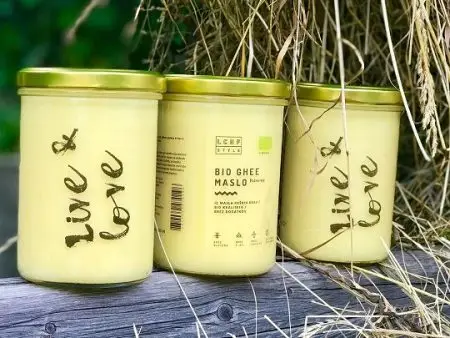
Ghee butter has been around for thousands of years. Its history goes back to Indian and Ayurvedic cuisine, where it is also called liquid gold, mainly because of its valued healing effects.
A case of pure butter fat, which has a lot in common with regular butter, as it is produced from butter, but at the same time has some key differences, as we will learn below. You could say that Ghee butter is an upgraded version of regular butter. It is characterized by a richer buttery taste, a much higher smoke point (which is extremely important when heating) and a better composition. Above all, it should be emphasized that Ghee butter does not contain lactose and casein! It is made by slow heating, which causes all the water, salt and milk proteins to be expelled. Only pure butterfat remains, without traces of milk products, lactose and casein. Therefore, BIO Ghee butter is an excellent choice for anyone with lactose intolerance and an allergy to dairy products.
Let’s start at the beginning. What are the essential characteristics of Ghee butter?
1. High smoke point:
We know that if we heat butter in a pan, it will turn brown fairly quickly, or it will start to smoke from the pan if the temperature is too high. This is called the smoke point and describes the temperature at which the breakdown of molecules and the formation of harmful free radicals begins. Ghee butter has a smoking point of around 250oC (482 oF), which is higher than all normal fats. In comparison, coconut oil and regular butter have a smoke point of around 176oC (350 oF), and extra virgin olive oil around 160oC (320 oF).
2. It contains many fat-soluble vitamins
Ghee butter is rich in vitamins A, D, E and K. This is especially important for people with gastrointestinal diseases (irritable bowel syndrome, Crohn’s disease, celiac disease…) where the absorption of vitamins is difficult. If we choose BIO Ghee butter from pasture the vitamin content is even better, because the cows graze outdoors, on sunny pastures (vitamin D!) and the production of butter, from which BIO Ghee butter is made, meets the highest criteria.
3. Ghee does NOT contain lactose and casein
The most important feature of ghee butter is that it does not contain lactose and casein. This is extremely important for anyone who suffers from lactose intolerance and who cannot consume dairy products in general. Casein and traces of lactose, which are present in ordinary raw butter, are completely removed in the process of preparing Ghee butter. BIO Ghee butter from pasture is subjected to strict analyzes regarding the content of lactose and casein and the analyzes confirm that the product is completely lactose-free and casein-free.
4. Ghee contains conjugated linoleic acid (CLA)
Conjugated linoleic acid is one of the non-essential fatty acids. It should also have the potential to protect against the onset of cancer, help prevent cardiovascular diseases and contribute to more successful weight loss. Research in the field of CLA’s impact on health has recently been accelerating the discovery of more and more new positive effects.
5. Contains butyric (butanoic) acid and lauric acid
Butyric acid is a short-chain fatty acid that plays an important role in gut and gastrointestinal health. Some studies also demonstrate the effect on insulin regulation and the reduction of inflammatory processes, which is especially important for people with gastrointestinal diseases and various ulcers on the stomach or intestines. Lauric acid has an antimicrobial and antifungal effect and also affects the rate of metabolism.
6. It has a pleasant buttery taste
In the process of heating raw butter, all impurities and water are removed, which is why Ghee butter has a more intense buttery taste and smell than ordinary butter. It has a deep, rich and slightly nutty aroma and is ideally complemented with various savory and sweet dishes. If it is used together with spices, the dish will be much more aromatic, as it emphasizes their aroma.
7. Contains vitamin K
Vitamin K is an important vitamin for our health – among other things, it prevents blood clots, contributes to the health of the cardiovascular system and maintains bone density, which is especially important for women.
8. It can also be used for skin and hair
Ghee is used in Ayurvedic medicine to treat various skin injuries, cracks, eczema… It also helps with dry skin, as it provides natural oily protection.
9. Long shelf life
Ghee butter has another exceptional property – it is very stable at room temperature, in a dark place. Since it is a clean and stable fat with saturated fatty acids, the oxidation process is almost impossible.
Ways to use Ghee butter
There are countless ways to use Ghee butter. It is an ideal alternative to classic butter, as it does not lose any of its good properties when heated. You can cook with it, bake, add it to boiled vegetables, salads, roasted meat… It can also be added to coffee, tea, sauces, soups… You can find the recipe for making coffee with butter here. It is also ideal for traveling, camping, hiking… because it does not need to be stored in a cold place.
Prepare the following LCHF pancakes on BIO Ghee butter and the difference will be obvious! Need a pancake recipe? Take a look at our recipes!
Sources:
https://draxe.com/ghee-benefits/
https://blog.kettleandfire.com/ghee-vs-butter/
https://en.wikipedia.org/wiki/Ghee
https://www.yogapedia.com/definition/5434/ghee
https://articles.mercola.com/sites/articles/archive/2017/02/06/ghee-benefits.aspx
10.06.2018, Katja, LCHF Style


You must be logged in to post a comment.