

1



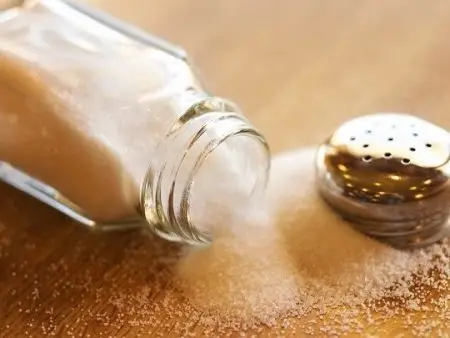
The amount of salt is a similar topic as the amount of fat. We all have it rooted in our heads that too much salty food and too much salt is extremely harmful and each of us can list a bunch of problems that can happen to us if we eat too much salt. In fact, the issue is completely justified as long as we eat “a classic diet” and our energy source is glucose – i.e. carbohydrates. And that’s that. Unfortunately, we are not aware of the importance of salt in the LCHF/KETO diet, as we do not even know its role in the body.
Let’s see what happens to the metabolism when we switch to fat as an energy source.
In glucose-based metabolism, the liver produces glycogen. Glycogen is soluble in water and is transported through the blood through the body to the cells and tissues that need it for energy. Glycogen is stored in the muscles and liver and is available when the body needs it. These are called glycogen stores. Glycogen is stored in liquid form – sources state that 1g of glycogen is stored in 3-4g of water.
When we decide to change our diet and severely limit carbohydrates in our diet, we no longer need glucose as a fuel source. Therefore, there is no glycogen production. And what happens next? The body has a new source of energy – these are fatty acids from which the liver makes ketones. We wrote about ketones in the blog What are ketones? And since the body no longer needs glucose and glycogen, it gets rid of it. How? Through the elimination of excess water. This is also one of the reasons why the weight loss is very quick in the beginning. We say that the water goes away. And that’s actually true.
And what does salt have to do with it???
We discovered that the organism gets rid of the water and glycogen reserves on the LCHF/KETO diet. How? Through urine and sweat.
As a result it can happen that our electrolyte balance is disrupted and even slight dehydration can occur. The combination of lack of electrolytes (sodium in salt is one of the most important electrolytes) and dehydration can cause such problems as:
But if the matter is not too simple, INSULIN also comes into play.
One of the lesser-known tasks of INSULIN is also signaling to the kidneys regarding water and salt retention. When we eat carbohydrates, insulin rises. The kidneys receive a signal that they must retain salt or water that contains salt and must not be excreted. So, a classic hydrated diet that is (too) rich in salt can actually be dangerous. A larger amount of salt retained by the kidneys (with increased insulin) can lead to kidney damage, increased blood pressure, etc…
However, when we eliminate or severely limit carbohydrates from our diet, the opposite happens.
There is no insulin fluctuation (because there is no glucose intake), which means that the kidneys get a signal to excrete excess stored water. And this is the reason that the body does not retain water on the LCHF/KETO diet and most people notice that they are no longer bloated. All electrolytes also leave through water, which our kidneys regularly and correctly drain. You can read more about electrolytes in the blog The importance of electrolytes in the LCHF/KETO diet.
For these two main reasons described (no glycogen and no insulin fluctuation) it is very important to carefully monitor salt intake on the LCHF/KETO diet. This is extremely important at the beginning, when the organism is not yet adapted and it happens very quickly that there is a serious deficiency or dehydration. It usually manifests itself in the form of problems mentioned at the beginning.
And how much salt should you consume daily?
Basically, sodium is the important element in salt that we need.
The daily need for sodium is between 5,000 mg – 7,000 mg. And how do we convert this into the required amount of salt? 1g of salt contains approximately 388 mg of sodium. So a simple calculation shows that it is necessary to consume 13-18 g of SALT per day. That’s 2 actual teaspoons of salt! It is necessary to make an effort to meet such a quantity. It is imperative to monitor sufficient salt intake during increased physical activity, in the summer and on fasting days. Of course, we must not forget about other electrolytes, such as magnesium and potassium!
Pass me the salt, please!
Sources:
https://ketogains.com/2017/06/keto-flu-electrolyte-imbalances/
https://www.youtube.com/watch?v=MGDZI7FzqW8
https://www.ketovangelist.com/salt-the-prize-jewel-of-keto/
04.02.2018, Katja, LCHF Style




You must be logged in to post a comment.